Sharing data is an essential aspect of Open Science for advancing scientific progress, fostering transparency in research, and maximizing the effective use of public investments and research resources Jwa & Poldrack, 2022.
Sharing data is increasingly encouraged across various research fields and more and more required by funding agencies. In Musculoskeletal (MSK) Imaging, the amount of shared data is still limited. Some of the main challenges refer to the understanding of the complex regulatory landscape — particularly concerning ethical and legal issues, such as data privacy — and technical competences — including data de-identification, data anonymization, and choosing a data repository.
In these guidelines, we aim to clarify the main aspects involved in sharing MSK Imaging data, with the hope to facilitate data sharing in the MSK imaging scientific community. We will often refer to the ongoing work in the Neuroimaging scientific community, where a more extensive body of literature and data repositories are already established.
These guidelines are curated by members of the Open and Reproducible Musculoskeletal Imaging Research (ORMIR) community, who aims to promote a culture of openness and reproducibility in MSK imaging research through development of open and reproducible software, development of standardized acquisition and analysis workflows, and promotion of open data sharing practices. These guidelines were initiated during the 2nd ORMIR workshop Sharing and Curating Open Data in Musculoskeletal Imaging Research held in January 2024, and are being updated periodically.
What’s the role of researchers in data sharing?
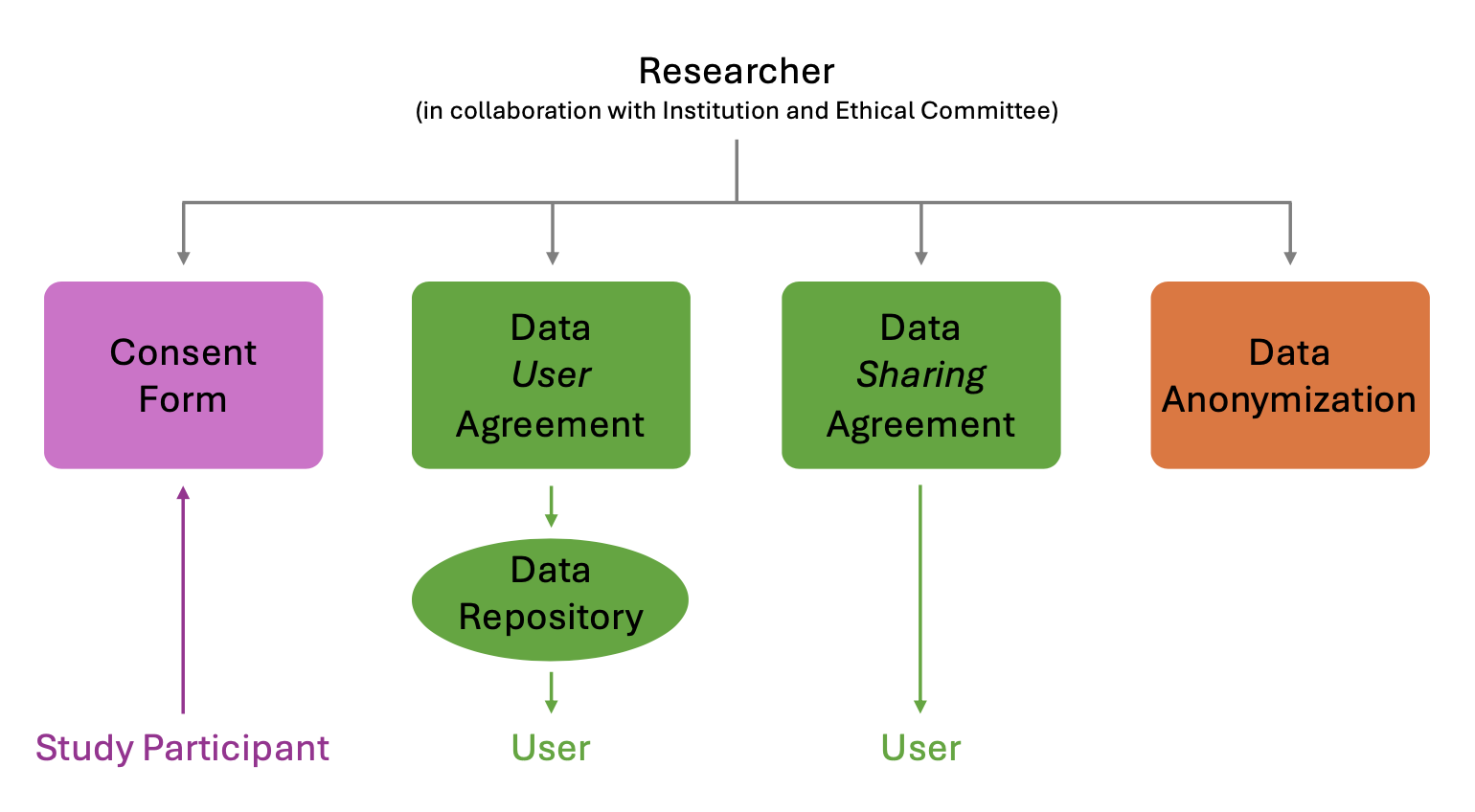
When researchers want to share MSK imaging data, they should collaborate with their Institutions and local Ethical Committees to prepare the following documents:
An consent form, which provides participants detailed information about the study, including its purpose, procedures, potential risks, benefits, and their rights
A data user agreement, which defines how users can access and utilize participants’ data shared in a data repository
A data sharing agreement, how users can access and utilize participants’ data shared with another institution
Note that:
A consent form is a formal document between a researcher and a participant
A data user agreement and a data sharing agreement are a formal documents between a researcher and data users
In addition, it is responsability of the researchers to de-identify or anonymize the data before sharing them with third parties, and to choose the appropriate data repository
What’s in these guidelines?
The material you’ll find in these guidelines is meant to support you in the conversation with your Institution and your local Ethical Committee, so that you can share your study data with other researchers.
In these guidelines, you will find:
Variations among countries, states, and institutions
There are several differences among countries, states, and institutions about the legislation concerning data sharing. Here are some of the peculiarities for European Union and United States — if you want to add the documentation about your country, please contribute to this page!
General regulations
In the European Union, data sharing is based on the General Data Protection Regulation (GDPR), released in 2018 Bannier et al., 2021. The GDPR concerns data storage, transfer, and sharing both within and outside the European Union and gives the institutions a greater responsability to safeguard the privacy of personal data White et al., 2022.
In the United States, data sharing is based on the Belmont Report: Ethical Principles and Guidelines for the Protection of Human Subjects of Research (National Commission for the Protection of Human Subjects of Biomedical and Biobehavioral Research, 1978), which laid out three core ethical principles, that is, respect for persons, beneficence, and justice. The implementation of the ethical principles of the Belmont Report resulted in a multitude of federal regulations and policies. Amont these, the Common Rule — codified by Department of Health and Human Services — was adopted by many federal departments and operates as the standard for ethical conduct and government-funded research Jwa & Poldrack, 2022. The Health Insurance Portability and Accountability Act (HIPAA) is a federal law enacted to protect the privacy and security of individuals’ medical records and other personal health information. It governs how healthcare providers, insurance companies, and other entities handle patient data. For a complete overview of the legal landscape in the United States, we recommend the article by Jwa & Poldrack, 2022.
International recommendations by the World Medical Association include the Declaration of Helsinki (2001), which defines ethical principles for medical research involving human subjects and the Declaration of Taipei (2017) which defines ethical principles for health databases, big data, and biobanks Bannier et al., 2021.
Data ownership
Knowing who owns the data is important because “whoever owns the data has control over the data, its dissemination, and the timing of dissimination” White et al., 2022. Owners can be:
Researchers and/or academic institutions sponsoring research projects
Funding agencies sponsoring research projects (e.g. NIH in the United States)
Study participants. The European GDPR provides more rights to the individuals, including the “Right to be Forgotten”, that is, the right to request to erase personal paper and electronic research history White et al., 2022
Currently, there is no consensus on data ownership.
About these guidelines
The development of these guidelines started during the 2nd ORMIR workshop Sharing and Curating Open Data in Musculoskeletal Imaging Research in Zurich, Switzerland, 15-18 January 2024.
The authors and maintainers are (in alphabetical order):
Andrew Burghardt,
Andy Kin On Wong,
Fulvia Taddei,
Kathryn Stok,
Sarah Manske,
Serena Bonaretti, and
Vincent Stadelman.
Citation
If you use this work, please cite it as:
Burghardt, A., Wong, A. K. O., Taddei, F., Stok, K., Manske, S., Bonaretti, S., & Stadelmann, V. (2025). ORMIR Data sharing guidelines (v1.0). Zenodo.
Contribute!
If you would like to contribute, send a pull request to our GitHub repository or email to ormircommunity@gmail
- Jwa, A. S., & Poldrack, R. A. (2022). The spectrum of data sharing policies in neuroimaging data repositories. Human Brain Mapping, 43(8), 2707–2721. https://doi.org/10.1002/hbm.25803
- Bannier, E., Barker, G., Borghesani, V., Broeckx, N., Clement, P., Emblem, K. E., Ghosh, S., Glerean, E., Gorgolewski, K. J., Havu, M., Halchenko, Y. O., Herholz, P., Hespel, A., Heunis, S., Hu, Y., Hu, C.-P., Huijser, D., de la Iglesia Vayá, M., Jancalek, R., … Zhu, H. (2021). The Open Brain Consent: Informing research participants and obtaining consent to share brain imaging data. Human Brain Mapping, 42(7), 1945–1951. https://doi.org/10.1002/hbm.25351
- White, T., Blok, E., & Calhoun, V. D. (2022). Data sharing and privacy issues in neuroimaging research: Opportunities, obstacles, challenges, and monsters under the bed. Human Brain Mapping, 43(1), 278–291. https://doi.org/10.1002/hbm.25120